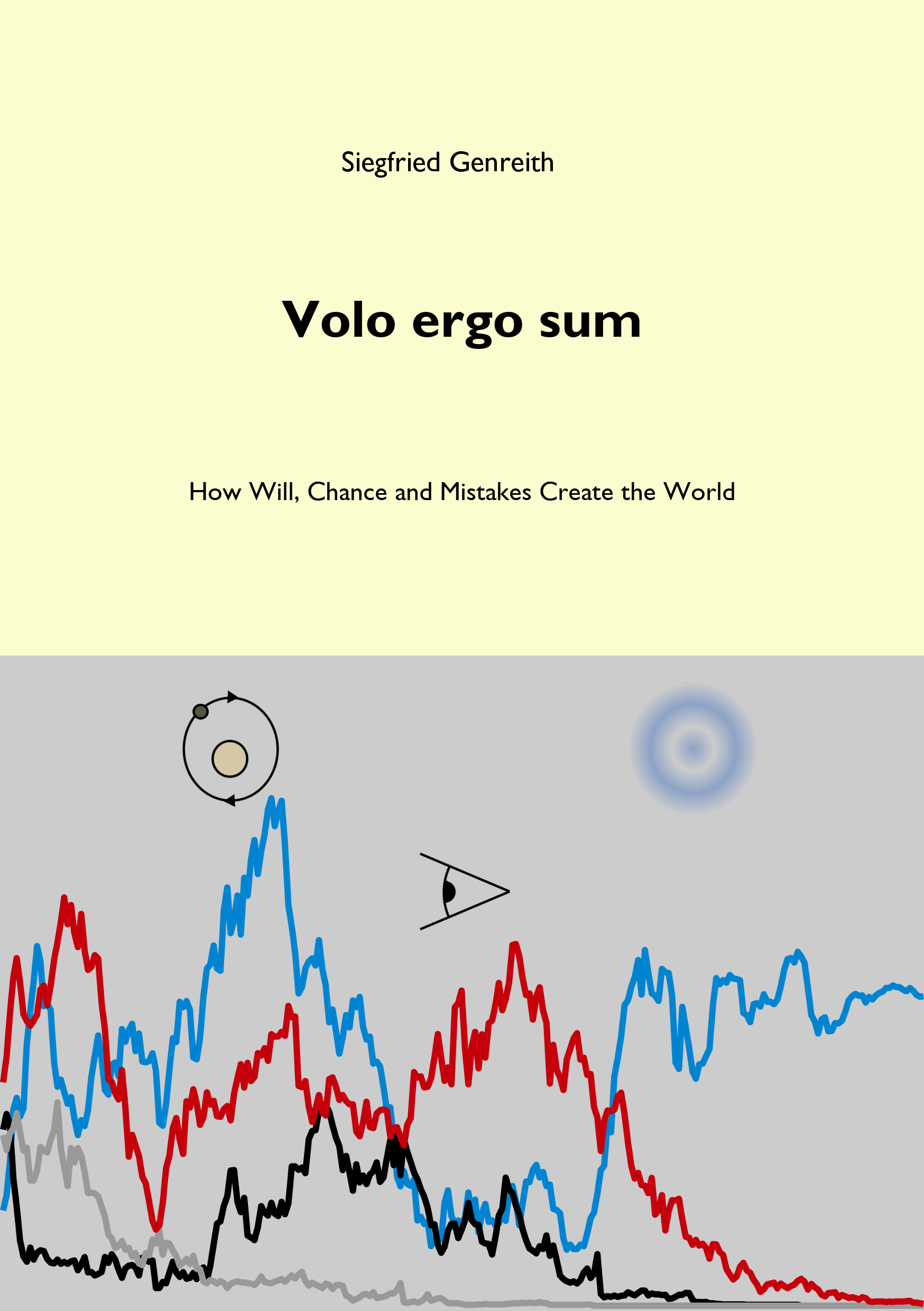
How Will, Chance and Mistakes Create the World
Modern science is precise, successful—and possibly fundamentally misguided. It describes the world with impressive accuracy, yet for over a century it has been failing to answer its deepest questions: What is time? What is chance? What is consciousness? And why can't quantum mechanics and gravity be reconciled?
In *Volo ergo sum*, Siegfried Genreith presents an uncomfortable thesis: Not order, but chance is fundamental. The world is not created by laws, but by a self-referential process that stabilizes itself step by step. Gravity appears not as a force, but as a statistical effect. Time is not continuous, but arises from events. Consciousness is not a mysterious addition to matter, but a form of order in time.
At the heart of this is the GenI model, an evolutionary random process that reproduces both the quantum mechanical measurement process and gravitational dynamics—without fine-tuning, without hidden control variables. Free will is not dismissed, but taken seriously as a real cause: *Volo ergo sum*—I will, therefore I am.
Genreith combines personal reflections, philosophical rigor, and physical modeling to create a radical shift in perspective. The book deliberately avoids mathematical formalism, but not intellectual rigor. It challenges the reader to rethink familiar categories such as objectivity, causality, and reality.
This book does not aim to please. It aims to unsettle, provoke, and initiate a long-overdue debate.
ISBN: 978-3-6957-1149-9 (Link zum Buchshop)